 English
 Nederlands
  Deutsch
  Italiano


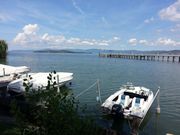
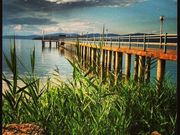




The lake Trasimeno is surrounded by a crown of hills, partly Umbrian and partly Tuscan. The surrounds are enriched with a multitude of small rustic villages that are overlooking the lakeshore and spread around the hills.
The castle in the centre of town is entirely surrounded by walls. It rises up on the small promontory like a ship plunging into the waters of Lake Trasimeno. The whole town is dominated by the medieval fortress with its 30 metres high tower that stands out against the sky. It contains the Doge’s Palace, that is completely lined with frescos.
Lakeside, Castiglione del Lago offers all aquatic sports, like sailing, windsurf, water skiing, canoeing, swimming and bathing. It is possible to go trekking or ride a mountain-bike with bike trails hugging the shore of the lake, far away from noise and asphalt; there are also tennis courts, beach-volley courts, handling and horse-riding.
International festivals like the “Festa del tulipano” (Tulip Fest) in April, “Aquiloni” (Kites) at the beggining of May or “Trasimeno Blues” in July, have brought renown and popularity to the Trasimeno township.
The centre of village is enclosed by fourteenth-century walls and even today has a very medieval look that proudly maintains one of the most narrow lanes in Italy: the Via Baciadonne.
Further on there is the tower of Public. A 38 metres high structure that was built around 1000 a.d.. There are also the churches Santa Maria of Mercede and Sant’Agostino which contain the preserved fresco of Perugino and a table of Pomarancio respectfully. Don’t forget to visit the Fortress and the church of S.Francesco from XIII century, the sanctuary of Madonna of Fatima that is sheltering works from the local school and one “Pentecost” of Pomarancio.
To conclude the visit you can also see the works of the most famous city artist, Pietro Vannucci inside the churches of S.Maria dei Servi and S.Antonio Abate. Between all the points of interest in the town the most important without a doubt is Palio dei Terzieri (Palio from the Tertiary period).
Is placed up on the hill on the eastern side of Trasimeno lake. The name Magione starts to be mentioned from the year 1075 a.d., and it comes from the Castle of Knights of Malta.
The Castle was made up as hospitium (hospitalization) for the pilgrims with destination - Rome or Jerusalem, and for the ones that followed the itinerary of San Francesco in direction of Santiago de Compostela. Nowadays the Castle is in the town area and it’s characterized by a square formed tree with circular towers and a yard with loggies. The Castle is also the administrative office of the agricultural concern with the same name.
As ever the Castle is summer residence of the Prince and Grand Master of Order of the Knights of Malta who likes to spend the month of september at the lakeside.
Most events are bounded with the motor racing track in the neighbourhood, between that very important are also newly organized classic music events with the goal to re-establish an old custom.
Like the main part of the centers in the region is still keeping the medieval aspect with ruins of town walls and fortress doors.
The most specific thing about the town is the possibility to enjoy the magnificent panoramic views over the Trasimeno lake and valley of stream Nestore.
For enthusiasts of museums and antique cloths it’s absolutely necessary to visit the tulle museum “Anita Belleschi Grifoni”, inside the beautifull Renaissance church of S. Agostino. Also the Porta Fiorentina and the museum of sacred objects inside the church Chiesa della Sbarra (1600 a.d.).
Panicale is famous also for its classic music event, called “Musica insieme a Panicale”.
Placed on the northern side of the lake, where the lake findes the rocks, Passignano is a nice combination of nature and history, art and folklore, quietness and vitality.
The most ancient living area in town is nowdays still surrounded by medieval walls that are making significant testimony about Passignanos growth.
The small farmers village during the Roman Empire become the castle in period of the seigniory of the Ugguccione II in 917 a.d. and after that remains long contested between Arezzo, Perugia and Florence.
Famous for it events as “Palio delle Barche” (Palio of the boats) or the “Festa della Padella” (Frying pan Fest), and “Trasimeno Blues”.
Placed on dominant position on the small relief that streches out over the northern plain of lago Trasimeno where in the year 217 b.c. the famous battle took place; between the Carthaginian army under the leadership of Hannibal Barca and two Roman legions under command of Caio Flaminio Nepote.
Tuoro is famous for evoking the story of “Hannibals battle” but also more recently known for the “Trasimeno Blues” event.
From Trasimeno lake three island are visible:
With it’s 70 hectars it is the widest island inside the Trasimeno lake, and it represents a very interesting station from historical and naturalistic point of view.
Island Polvese is witness of the time and history, that goes until the Roman epoch. There are the ruins of Convent of the Olivetans and the walls of the Castle from XIV century.
In the island area there are three main vegetation zones:
Still nowadays it preserves the caracteristic aspect of the 15th century village created by the fishermen. The Guglielmi Castleincompasses the convent of Saint Francis Minorites; furthermore the island gave a shelter to Saint Francis in the 1213 a.d.
The needle lace from the island (or Irish lace), a valuable craft handwork propagated and taught by one Irish teacher, fishing and tourism are the main economical base for the local families.
Not so wide as the other two islands. Called “isled” untill the start of the twentieth-century. Nowadays the island is private and uninhabited, under municipal district of Passignano.

 |
 |
 |
 |
 |
 |
 |
 |
 |
 |
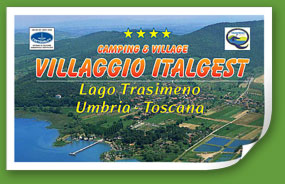
Camping Villaggio Italgest - Via Martiri di Cefalonia - 06063 Sant'Arcangelo - Magione (Perugia)
Phone: (+39) 075.848238 Mob: (+39) 335.5426212 Fax: (+39) 075.848085 Email: [email protected]
Trasimeno Lake - GPS: 043° 05' 29" N 012° 09' 37" E


