 English
 Nederlands
  Deutsch
  Italiano


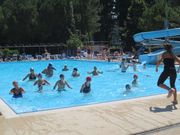

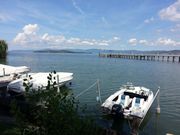
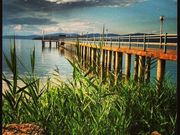






Trasimeno is a special inland lake with no natural drainage. It is set in a basin of surrounding hills and is quite shallow. The surface of the lake is 126 square kilometres; The average depth is only 4,72 m with a maximum of only 6,3 m.
The water supply to Lake Trasimeno is predominantly the rainwater that comes down from the surrounding hills.
However, the major tributary is the artificial canal of Anguillara located near Panicarola, which gathers the water of streams Tresa, Rio Maggiore, Moiano and Maranzano.
Near S. Savino there is also an artificial drain (partly underground) that serves as lake level regulator. In the event of excess rainfall, this facility can pump out water through to the Caina and eventually reaching the Tevere.
The first “drain” was excavated in Roman times during the reign of the Emperor Claudio. This finally ended the dreadful floods of the lake which followed long and intense rain periods.
In 1422 the drain was again restored by Braccio Fortebraccio from Montone. There have been other interventions that have attempted to control the Trasimeno waters, but only in the last century the lake has been successfully controlled by a really efficient drain, which is the current one.
Without constant natural drainage, the shallow waters of Lake Trasimeno have a eutrophic effect, where by mineral salts and nutrients build up and accelerate the plant and wild life growth. This means the lake is full of life for both flora and faun.
Due to it’s extraordinary environmental value and for the development policies that were introduced, in 2005 lake Trasimeno qualified to join the international chain of LIVING LAKES, under high patronage of the GLOBAL NATURE FUND of UNESCO.
The quality of habitat is constantly monitored by the REGIONAL AGENCY FOR ENVIORMENTAL PROTECTION (ARPA). The quality of water is kept under constant control enabling it to also be certified suitable for swimming.
Other environmental indicators such as air and land quality are also monitored with excellent results.
By establishing a project of placing the quality of the region as a high priority and guaranteeing compatible development, The Trasimeno district has shown its commitment to the adopted model of AGENDA 21 LOCAL in accordance with protocols from the Conference of Rio de Jeneiro from 1992.
The park of lake Trasimeno, established under the Regional Law Act n.9 on 3rd March 1995, and updated under the Regional Low Act n.24 on 23rd July 2007. Park of Trasimeno lake is the largest of the seven Umbrian Regional Parks. The territory of the Park, defined as the State Property, spreads over the perimeter of the lake Trasimeno and covers approximately 13.200 hectars over the territories of the municipal areas of Castiglione del Lago, Magione, Panicale, Passignano and Tuoro.
From the naturalistic aspect the Park is humid zone of great importance where in harmony are living together geomorphologic, botanic, faunal and ichthyic habitats.
The lake Trasimeno is admitted by the EU directive 92/43/CEE known as Habitat Directive of the Public Interest (IT 5210018) and also EU directive 79/409/CEE known as Directive Birds Zone under the Special Protection (IT 5210070).
Within the projects of AGENDA 21 LOCAL, the environmental manifest of Trasimeno is a guaranty and safeguarding mark for tourists and residents. It is assigned just after inspection by the specialised agency for the certification. Possibility of geting it is strictly for the touristic activities which have adopted quality systems and environmentaly friendly.
There are no monsters in the shallow water of Trasimeno, but anyway the lake has its legend, a love story. It’s a story with a tragical end, narrated also nowadays by local elderly fishermen.
Trasimeno lake is the fourth largest lake in Italy, and it is called after the name of the son of Etrurian King Tirren present in the zone. One day from the camp the son of King Tirren Trasimeno, saw a nymph, Agilla (a village Agello in the zone still carries her name) while she was bathing. Between the two of them the overpowering love was born, the irrepressible passion and desire.
The King Tirren, after a thousand refusals, gave permission for a marriage between the two and agreed to make a wedding celebration with all honours.
But the happiness of the married couple lasted just one day. The morning after the wedding, Trasimeno decided to bathe in the lake.
Agilla looked in his direction from the tent on the lakeshore seeing him plunging into the water. But the young man didn’t surface again.
From that day Agilla remained to wait for her beloved one, seeking for him continuously.
She ended her days on the boat, in the middle of the lake, from where she controlled all boats and crafts on them searching for the face of her lost beloved one.
The fishermen are saying that also nowadays, during the summer, when the wind blows from Tuscany, you can hear the weeping of the nymph calling her love.

 |
 |
 |
 |
 |
 |
 |
 |
 |
 |
Camping Villaggio Italgest - Via Martiri di Cefalonia - 06063 Sant'Arcangelo - Magione (Perugia)
Phone: (+39) 075.848238 Mob: (+39) 335.5426212 Fax: (+39) 075.848085 Email: [email protected]
Trasimeno Lake - GPS: 043° 05' 29" N 012° 09' 37" E


