HOME | DAS VILLAGE | WIR SIND HIER | TRASIMENO | STELLPLÄTZE | MOBILHEIME | INFO | RESERVIERUNGEN
Villaggio Italgest heisst willkommen

Geöffnet 2012:
02/04 - 30/09
GPS:
043° 05' 17" N
012° 09' 23" E
Sonderangebott

~ 4=3, 7=4, 14=10 in der Nachsaison

~ 7=5, 14=11 in der Mittensaison

~ 7=6 in der Mitten/Hochsaison

~ Spezialpreise für Gruppen und Treffen in der Nach- und Zwischensaison.


INTERNATIONALE KUNDEN
The Trasimeno Area


TRASIMENO LAKE

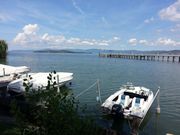
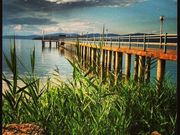
Trasimeno is a special inland lake with no natural drainage. It is set in a basin of surrounding hills and is quite shallow. The surface of the lake is 126 square kilometres; The average depth is only 4,72 m with a maximum of only 6,3 m.
The water supply to Lake Trasimeno is predominantly the rainwater that comes down from the surrounding hills.
However, the major tributary is the artificial canal of Anguillara located near Panicarola, which gathers the water of streams Tresa, Rio Maggiore, Moiano and Maranzano.
Near S. Savino there is also an artificial drain (partly underground) that serves as lake level regulator. In the event of excess rainfall, this facility can pump out water through to the Caina and eventually reaching the Tevere.

The first "drain" was excavated in Roman times during the reign of the Emperor Claudio. This finally ended the dreadful floods of the lake which followed long and intense rain periods.
In 1422 the drain was again restored by Braccio Fortebraccio from Montone. There have been other interventions that have attempted to control the Trasimeno waters, but only in the last century the lake has been successfully controlled by a really efficient drain, which is the current one.
Without constant natural drainage, the shallow waters of Lake Trasimeno have a eutrophic effect, where by mineral salts and nutrients build up and accelerate the plant and wild life growth. This means the lake is full of life for both flora and faun.

Due to it's extraordinary environmental value and for the development policies that were introduced, in 2005 lake Trasimeno qualified to join the international chain of LIVING LAKES, under high patronage of the GLOBAL NATURE FUND of UNESCO.
The quality of habitat is constantly monitored by the REGIONAL AGENCY FOR ENVIORMENTAL PROTECTION (ARPA). The quality of water is kept under constant control enabling it to also be certified suitable for swimming.
Other environmental indicators such as air and land quality are also monitored with excellent results.
By establishing a project of placing the quality of the region as a high priority and guaranteeing compatible development, The Trasimeno district has shown its commitment to the adopted model of AGENDA 21 LOCAL in accordance with protocols from the Conference of Rio de Jeneiro from 1992.

TRASIMENO AND ITS SUBURBS

The lake is surrounded by a crown of hills, partly Umbrian and partly Tuscan. The surrounds are enriched with a multitude of small rustic villages that are overlooking the lakeshore and spread around the hills.

Castiglione del Lago

The castle in the centre of town is entirely surrounded by walls. It rises up on the small promontory like a ship plunging into the waters of Lake Trasimeno. The whole town is dominated by the medieval fortress with its 30 metres high tower that stands out against the sky. It contains the Doge's Palace, that is completely lined with frescos.

Lakeside, Castiglione del Lago offers all aquatic sports, like sailing, windsurf, water skiing, canoeing, swimming and bathing. It is possible to go trekking or ride a mountain-bike with bike trails hugging the shore of the lake, far away from noise and asphalt; there are also tennis courts, beach-volley courts, handling and horse-riding.

International festivals like the "Festa del tulipano" (Tulip Fest) in April, "Aquiloni" (Kites) at the beggining of May or "Trasimeno Blues" in July, have brought renown and popularity to the Trasimeno township.

Città della Pieve

The centre of village is enclosed by fourteenth-century walls and even today has a very medieval look that proudly maintains one of the most narrow lanes in Italy: the Via Baciadonne.

Further on there is the tower of Public. A 38 metres high structure that was built around 1000 a.d.. There are also the churches Santa Maria of Mercede and Sant'Agostino which contain the preserved fresco of Perugino and a table of Pomarancio respectfully. Don't forget to visit the Fortress and the church of S.Francesco from XIII century, the sanctuary of Madonna of Fatima that is sheltering works from the local school and one "Pentecost" of Pomarancio.

To conclude the visit you can also see the works of the most famous city artist, Pietro Vannucci inside the churches of S.Maria dei Servi and S.Antonio Abate. Between all the points of interest in the town the most important without a doubt is Palio dei Terzieri (Palio from the Tertiary period).

Magione

Is placed up on the hill on the eastern side of Trasimeno lake. The name Magione starts to be mentioned from the year 1075 a.d., and it comes from the Castle of Knights of Malta.
The Castle was made up as hospitium (hospitalization) for the pilgrims with destination - Rome or Jerusalem, and for the ones that followed the itinerary of San Francesco in direction of Santiago de Compostela. Nowadays the Castle is in the town area and it's characterized by a square formed tree with circular towers and a yard with loggies. The Castle is also the administrative office of the agricultural concern with the same name.

As ever the Castle is summer residence of the Prince and Grand Master of Order of the Knights of Malta who likes to spend the month of september at the lakeside.
Most events are bounded with the motor racing track in the neighbourhood, between that very important are also newly organized classic music events with the goal to re-establish an old custom.

Panicale

Like the main part of the centers in the region is still keeping the medieval aspect with ruins of town walls and fortress doors.
The most specific thing about the town is the possibility to enjoy the magnificent panoramic views over the Trasimeno lake and valley of stream Nestore.

For enthusiasts of museums and antique cloths it's absolutely necessary to visit the tulle museum "Anita Belleschi Grifoni", inside the beautifull Renaissance church of S. Agostino. Also the Porta Fiorentina and the museum of sacred objects inside the church Chiesa della Sbarra (1600 a.d.).
Panicale is famous also for its classic music event, called "Musica insieme a Panicale".

Passignano sul Trasimeno

Placed on the northern side of the lake, where the lake findes the rocks, Passignano is a nice combination of nature and history, art and folklore, quietness and vitality.
The most ancient living area in town is nowdays still surrounded by medieval walls that are making significant testimony about Passignanos growth.
The small farmers village during the Roman Empire become the castle in period of the seigniory of the Ugguccione II in 917 a.d. and after that remains long contested between Arezzo, Perugia and Florence.

Famous for it events as "Palio delle Barche" (Palio of the boats) or the "Festa della Padella" (Frying pan Fest), and "Trasimeno Blues".

Tuoro sul Trasimeno

Placed on dominant position on the small relief that streches out over the northern plain of lago Trasimeno where in the year 217 b.c. the famous battle took place; between the Carthaginian army under the leadership of Hannibal Barca and two Roman legions under command of Caio Flaminio Nepote.

Tuoro is famous for evoking the story of "Hannibals battle" but also more recently known for the "Trasimeno Blues" event.

LAKE TRASIMENO AND ITS ISLANDS

From Trasimeno lake three island are visible:

Island Polvese

With it's 70 hectars it is the widest island inside the Trasimeno lake, and it represents a very interesting station from historical and naturalistic point of view.
Island Polvese is witness of the time and history, that goes until the Roman epoch. There are the ruins of Convent of the Olivetans and the walls of the Castle from XIV century.

In the island area there are three main vegetation zones:
  • The humid zone typical for this one is the cane-brake, larger on the south-eastern side of the island. In this zone pravails aquatic vegetation with the floating and underwatter hydrophites (water plants). Along the bank there are willows and poplars.
    The trees and ornamental shrubs are present near to the docking areas and the center area of the island. Along the paths there are linden trees, chestnuts and on the meadow areas also willows, tamarisks, acacias, pinetrees, platans and catalpas, hedges of euonymus and oleanders.
  • The wood occupies the northern bank of the island. The prevailing plant types are the typical ones for mediteranian areas such as holm oak (San Leonardo oak), manna-ash. In the underbushes there are mostly guelder rose, laurel, butcher's broom, privet, dogwood and on the sunny hillsides the spinyshrubs of wild blackthorn and may-blossom.
  • The cultivation areas (approximately 40 hectars) under wide-ranging olive groves are positioned on the southern side of island. In the oil mill directly on the island, with the cold pressing procedure, excellent quality biological olive oil is obtained. In the cultivation zones it is possible to find the old fruit trees (cherry tree, walnut, apricot, plum, fig tree) and along the inner pathways of the island also fences of rosemary and pomegranate tree.
    The island Polvese is also an environmental laboratory. All the projects are under the patrionage and ownership of the local goverment of province Perugia.

Island Maggiore

Still nowadays it preserves the caracteristic aspect of the 15th century village created by the fishermen. The Guglielmi Castle incompasses the convent of Saint Francis Minorites; furthermore the island gave a shelter to Saint Francis in the 1213 a.d.
The needle lace from the island (or Irish lace), a valuable craft handwork propagated and taught by one Irish teacher, fishing and tourism are the main economical base for the local families.

Isola Minore

Not so wide as the other two islands. Called "isled" untill the start of the twentieth-century. Nowadays the island is private and uninhabited, under municipal district of Passignano.

PARK of LAKE TRASIMENO

The park of lake Trasimeno, established under the Regional Law Act n.9 on 3rd March 1995, and updated under the Regional Low Act n.24 on 23rd July 2007. Park of Trasimeno lake is the largest of the seven Umbrian Regional Parks. The territory of the Park, defined as the State Property, spreads over the perimeter of the lake Trasimeno and covers approximately 13.200 hectars over the territories of the municipal areas of Castiglione del Lago, Magione, Panicale, Passignano and Tuoro.
From the naturalistic aspect the Park is humid zone of great importance where in harmony are living together geomorphologic, botanic, faunal and ichthyic habitats.
The lake Trasimeno is admitted by the EU directive 92/43/CEE known as Habitat Directive of the Public Interest (IT 5210018) and also EU directive 79/409/CEE known as Directive Birds Zone under the Special Protection (IT 5210070).

THE OASIS "LA VALLE"

The Oasis "La Vale" was created in the month of July 1996 with the regional presidental decree n° 161.
The Oasis extends on the territory of about 20 hectars, in the flat zone in municipal district of Magione. It is also called Piane di Spinetoli tra Pagliare del Tronto e San Pio X (Plain of spinets between Pagliare of Tronto and San Pio X).

The structure has established the Educational Environmental Center that includes:
  • a rich and interesting museum of folk wisdom,
  • three farm houses, from which one is used as territorial seat, the others as welcome centers for needy young people,
  • natural ponds with the sighting points,
  • rick of straw/ tools depot,
  • the small gallop with two horses,
  • eighty vegetable gardens, cultivated by elderly local people,
  • twelve corrals for the farm animals,
  • cycle/walking track aproximatelly 3 km long,
  • numerous naturalistic and rural runs

ENVIRONMENTAL MANIFEST OF TRASIMENO

Within the projects of AGENDA 21 LOCAL, the environmental manifest of Trasimeno is a guaranty and safeguarding mark for tourists and residents. It is assigned just after inspection by the specialised agency for the certification. Possibility of geting it is strictly for the touristic activities which have adopted quality systems and environmentaly friendly.
Every activity that passes through an audit gets one, two or three herons in corelation of the gained level during the certification. Our structure reached recognition of 3 herons.

THE LEGEND OF LAKE TRASIMENO

There are no monsters in the shallow water of Trasimeno, but anyway the lake has its legend, a love story. It's a story with a tragical end, narrated also nowadays by local elderly fishermen.

Trasimeno lake is the fourth largest lake in Italy, and it is called after the name of the son of Etrurian King Tirren present in the zone. One day from the camp the son of King Tirren Trasimeno, saw a nymph, Agilla (a village Agello in the zone still carries her name) while she was bathing. Between the two of them the overpowering love was born, the irrepressible passion and desire.
The King Tirren, after a thousand refusals, gave permission for a marriage between the two and agreed to make a wedding celebration with all honours.
But the happiness of the married couple lasted just one day. The morning after the wedding, Trasimeno decided to bathe in the lake.
Agilla looked in his direction from the tent on the lakeshore seeing him plunging into the water. But the young man didn't surface again.
From that day Agilla remained to wait for her beloved one, seeking for him continuously.
She ended her days on the boat, in the middle of the lake, from where she controlled all boats and crafts on them searching for the face of her lost beloved one.

The fishermen are saying that also nowadays, during the summer, when the wind blows from Tuscany, you can hear the weeping of the nymph calling her love.

USEFUL LINKS


NOT TO MISS UMBRIA

Marvellous Umbria, the only central Italian region without a seacoast, also called "Cuore verde d'Italia" (The Green Heart of Italy), offers a great variety of possible excursions. - Art destinations as Perugia (distant approximately 30 km), Assisi (45 km), Orvieto (55 km), Todi (70 km), Gubbio (55 km), - Gourmet goals as small villages at the limits with Tuscany (10-25 km max.), or Norcia (123 km), Castelluccio di Norcia (140 km), Montefalco (73 km), Bevagna (67 km); etc.

The strategical position of lake Trasimeno is giving an opportunity to arrive at places of great interests in a short time. To reach the destinations by car you need approximately: Siena 1h 30 min (100 km); Cortona 30 min (30 km); Florence 1h 15 min (140 km); Rome 1h 30 min (180 km).

The main events in Umbia, not to miss are:
  • Coloriamo i Cieli (Colour the sky) (end of April/beginning of May), at Castiglione del Lago;
  • Calendimaggio (1st May Day Festivity) at Assisi - recall of the past;
  • La festa dei Ceri (the Candle Fest) at Gubbio, a spectacular holy race along the city streets (middle of May);
  • Cantine Aperte (Open Wine Cellers) wine tasting at cellers in Trasimeno zone, Montefalco and Bevagna (last Sunday of May);
  • Infiorata (strewing and decorating the streets with flowers) at Spello in June;
  • La Fiorita (Blooming) spring colour explosion, in June at Castelluccio di Norcia;
  • La Giostra Quintana (Quintain Tournament), medieval amusement recall, June and September, at Foligno;
  • Il Mercato delle Gaite (historical recall of arts and proffesions) at Bevagna, at June;
  • Umbria Jazz Festival ( Jazz music concerts, some of them for free) at Perugia, first two weeks of July;
  • Trasimeno Blues (blues and jazz concerts some of them for free, at July and August), around the Trasimeno lake;
  • La settimana Montefalchese (Montefalchesian week), open country stile restaurants, at Montefalco, end of August;
  • Il Palio dei Terzieri (a historical recall, end of August/beginning of September), at Città della Pieve;
  • Bianco Rosso & Blues (the scents and tastes of wine and other typical products of Trasimeno are joined with Blues and Jazz; at September), around Lake Trasimeno;

Our reception will be glad to be at your disposal for any further information about the territory, or to create personal tours based on request.


HOME | DAS VILLAGE | WIR SIND HIER | STELLPLÄTZE | MOBILHEIME | INFO | RESERVIERUNGEN | MOBILE VERSION
Villaggio Italgest • Via Martiri di Cefalonia • 06063 Sant'Arcangelo - Magione (Perugia)
Tel.: (+39) 075848238 - Fax: (+39) 075848085 - E-mail: camping@italgest.com